LMS
LMS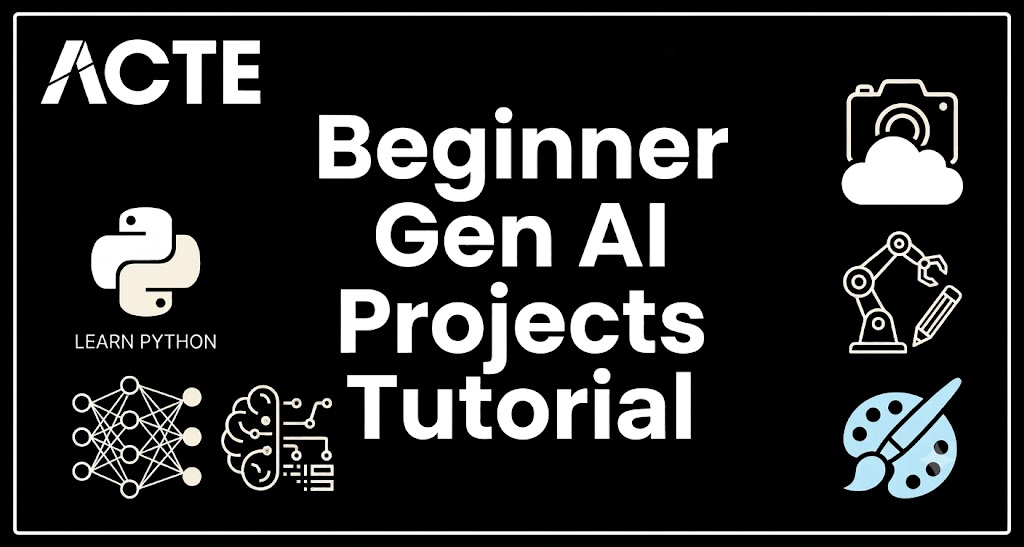
Last updated on 19th May 2026| 4572

- Introduction to Gen AI Projects Tutorial
- Setting Up Your Environment
- Basic Text Generation Project
- Simple Image Generation Project
- Beginner Chatbot Project
- Data Preparation and Prompt Engineering
- Hands‑On with GANs
- Mini Project on Transformers
- Real‑World Use Cases for Freshers
- Conclusion
Introduction to Gen AI Projects Tutorial
Gen AI Projects Tutorial are hands-on applications where learners build systems that create new content such as text, images, or conversations. Unlike theoretical study, projects provide practical exposure to how models work in real scenarios. For freshers, these projects are essential because they bridge the gap between classroom learning and industry expectations. They allow experimentation with creativity, coding, and problem-solving. Projects often start small, like generating text or images, and gradually expand into complex systems like chatbots or multimodal applications in Gen AI Course. Working on projects teaches debugging, evaluation, and deployment skills. It also builds confidence in handling datasets and prompts. Generative AI projects encourage innovation, as learners can design unique applications tailored to specific needs. They also prepare freshers for internships and entry-level roles. Ultimately, projects are the best way to learn by doing, making generative AI both accessible and exciting.
Setting Up Your Environment
- Installation: Python is the primary programming language for generative AI. Install frameworks such as TensorFlow and PyTorch using pip, and use Jupyter Notebook or Google Colab to build, test, and experiment with AI models. Google Colab is an excellent choice for beginners because it requires no local setup.
- Dependencies: Install essential libraries such as Hugging Face Transformers, Datasets, Tokenizers, OpenAI SDKs, and other preprocessing tools. Keeping dependencies updated ensures compatibility and stable performance. Learn more through the AI Content Creation Tools Tutorial.
- Configuration: Securely configure API keys, environment variables, and project settings before working with cloud-based large language models and AI services. Following secure credential management practices helps build professional development skills.
- Testing Setup: After installation, run sample scripts and test simple prompts to verify that models, APIs, and dependencies are working correctly. For practical guidance, explore the OpenAI Tools Tutorial for Beginners.
- Best Practices: Use virtual environments, maintain clear project documentation, version-control your code, update dependencies regularly, and create reproducible notebooks to ensure reliable, scalable, and professional AI development workflows.
Get Your Gen AI Certification by Learning from Industry-Leading Experts and Advancing Your Career with ACTE’s Gen AI Course.
Beginner Chatbot Project
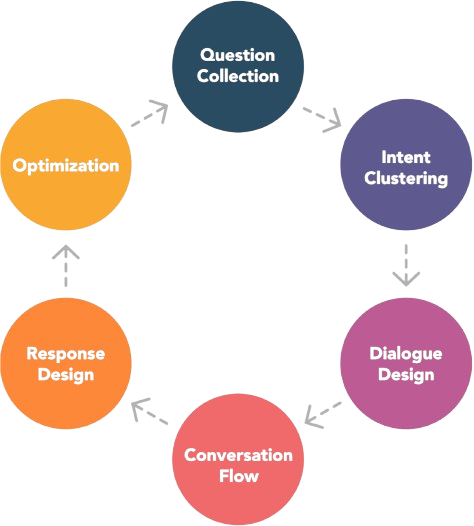
A chatbot project is an excellent way for freshers to explore conversational AI and understand how generative AI systems interact with users in real time. By leveraging large language models (LLMs), learners can build chatbots capable of answering questions, providing information, and simulating natural human conversations. The project typically starts with defining user intents, conversation flows, and response patterns to ensure meaningful interactions. Prompt engineering plays a crucial role in improving the relevance, accuracy, and quality of chatbot responses. As the project progresses, beginners can incorporate memory features that allow the chatbot to retain context across multiple interactions, creating a more personalized user experience in Gen AI Course. Learners also gain practical experience integrating APIs and deploying chatbots on websites, mobile applications, or messaging platforms. Through chatbot development, freshers learn important concepts such as dialogue design, natural language understanding, error handling, and user experience optimization. These projects can be further enhanced into customer support assistants, virtual tutors, appointment schedulers, or personal productivity assistants. Chatbot projects effectively demonstrate the practical value of generative AI by combining text generation with interactive communication. They make the learning process engaging while helping freshers develop industry-relevant skills. Additionally, building conversational AI systems provides valuable exposure to real-world business and educational applications, preparing learners for future opportunities in the rapidly growing field of artificial intelligence.
Data Preparation and Prompt Engineering
- Data Cleaning: Data preparation begins with removing duplicate records, handling missing values, correcting inconsistencies, and standardizing formats. Clean, high-quality datasets improve model performance, increase prediction accuracy, and produce more reliable AI outputs.
- Prompt Design: Well-structured prompts guide generative AI models to produce accurate, relevant, and context-aware responses. Using prompt templates, clear instructions, and sufficient context improves output quality. Learn effective prompting techniques through the Hugging Face Tutorial for Freshers.
- Evaluation: Evaluate prompts by testing different variations, comparing generated outputs, collecting feedback, and refining instructions to improve consistency, relevance, and overall response quality.
- Applications: Effective prompt engineering is widely used in text summarization, translation, content generation, chatbots, question answering, code generation, and creative writing, enabling organizations to automate a variety of AI-driven tasks.
- Best Practices: Document successful prompts, organize reusable prompt libraries, version-control prompt templates, collaborate with teams, and continuously refine prompts to build efficient, scalable, and professional AI workflows.
Hands-On with GANs
Generative Adversarial Networks (GANs) are one of the most influential deep learning architectures for AI-powered image generation. A GAN consists of two neural networks—a generator that creates synthetic images and a discriminator that evaluates whether the generated images resemble real data. Through adversarial training, both networks continuously improve, enabling the generator to produce increasingly realistic outputs. Beginners can start experimenting with simple datasets such as MNIST before progressing to more complex image generation tasks. Working on GAN projects helps learners understand concepts such as adversarial learning, loss functions, mode collapse, image synthesis, and model optimization. To strengthen your understanding of modern language models and generative AI, explore the ChatGPT and LLM Tutorial. Building hands-on GAN projects develops practical skills in deep learning, computer vision, and generative AI, preparing learners for advanced applications in digital art, design, content creation, and synthetic data generation.

Basic Text Generation Project
A basic text generation project is an excellent starting point for beginners learning generative AI and large language models (LLMs). Using models such as GPT, learners can build applications that generate blogs, articles, emails, stories, summaries, product descriptions, and other forms of written content based on user prompts. The project begins by designing effective prompts, generating responses, and evaluating the results for accuracy, relevance, coherence, and creativity. Through this process, beginners develop essential prompt engineering skills that improve the quality of AI-generated content. To strengthen your understanding of large language models, explore the LLM Tutorial. As learners gain experience, they can enhance their projects by implementing fine-tuning, output evaluation, content filtering, and workflow automation. Text generation projects can be extended into practical applications such as AI chatbots, content creation platforms, automated report generators, email assistants, and document summarization systems. Since these projects require relatively modest computational resources, they provide an accessible and practical way to build hands-on experience with generative AI while preparing learners for real-world AI development and intelligent automation.

Get JOB Oriented Gen AI Training for Beginners By MNC Experts
- Instructor-led Sessions
- Real-life Case Studies
- Assignments
Simple Image Generation Project
- Frameworks: Build image generation projects using Generative Adversarial Networks (GANs) or diffusion models with frameworks such as TensorFlow and PyTorch. Beginners can also use pre-trained models from Hugging Face to accelerate development and experiment with AI-generated images.
- Data Preparation: Collect high-quality image datasets, resize and normalize images, apply data augmentation techniques, and maintain balanced datasets to improve model performance and generate more realistic outputs.
- Training: Train image generation models by optimizing generators and discriminators or fine-tuning diffusion models. Monitor training progress, adjust hyperparameters, and use GPU acceleration to improve efficiency and image quality.
- Evaluation: Evaluate generated images by comparing them with real datasets using metrics such as Fréchet Inception Distance (FID), visual inspection, and user feedback. To explore AI application development, visit the LangChain Tutorial.
- Applications: AI image generation is widely used for digital art, product design, game development, marketing, synthetic dataset creation, medical imaging, and creative content production, providing beginners with valuable hands-on experience in generative AI.
Want to Master Gen AI? Explore the Gen AI Master Program Offered at ACTE Today!
Mini Project on Transformers
- Architecture: Encoder processes input sequences. Decoder generates outputs. Self-attention captures relationships. Positional encoding adds order. Architecture is complex. Freshers must study carefully and learn more from Large Language Model Tutorial.
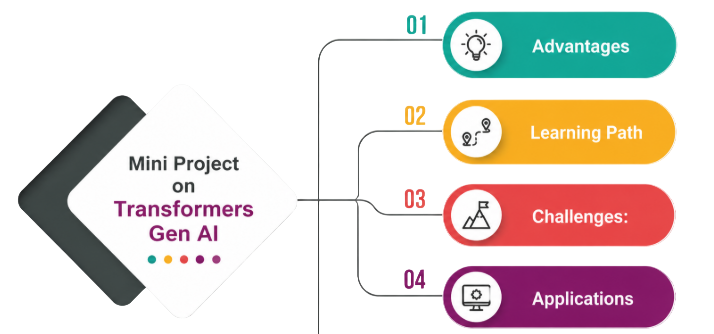
- Applications: Language translation, text summarization, question answering, and multimodal AI. Applications show versatility and inspire projects.
- Advantages: Parallel processing improves speed. Handles long sequences. Scales with large datasets. Powers GPT and BERT. Advantages explain success. Beginners benefit.
- Challenges: Require massive resources. Training costs are high. Risk of bias. Interpretability is limited. Challenges demand awareness and AI Image Generation Tutorial. Freshers must learn mitigation.
- Learning Path: Start with tutorials. Build small projects. Experiment with datasets. Compare outputs. Document findings. Freshers gain confidence.
Want to Learn About DevOps? Explore Our DevOps Interview Questions and Answers Featuring the Most Frequently Asked Questions in Job Interviews.
Real‑World Use Cases for Freshers
Generative AI projects offer a wide range of real-world applications that help freshers understand how artificial intelligence is transforming industries and solving practical problems. In healthcare, generative AI can create synthetic medical data for research and model training while maintaining patient privacy, whereas in finance, it supports fraud detection, risk assessment, and financial analysis in Gen AI Course. The education sector benefits from personalized tutoring systems, adaptive learning platforms, and automated content generation, while the entertainment industry uses AI to create artwork, music, animations, videos, and game assets. Businesses leverage generative AI for marketing content, product design prototypes, workflow automation, and customer support chatbots to improve efficiency and customer engagement. These applications demonstrate the versatility of generative AI across different domains and help freshers connect theoretical concepts with practical implementation. By working on real-world projects, learners gain hands-on experience, strengthen problem-solving abilities, build impressive portfolios, and improve their readiness for internships and job opportunities. Exposure to industry-focused AI applications also encourages creativity, innovation, and critical thinking while providing valuable insights into current market demands. As a result, freshers become more confident in applying their knowledge to professional environments and are better prepared to contribute to the growing field of artificial intelligence.
Conclusion
Gen AI Projects Tutorial provides a complete learning path for freshers to explore the world of generative artificial intelligence. Starting from environment setup and basic text or image generation, learners gradually progress to building chatbots, practicing prompt engineering, and experimenting with GANs and transformers. Each project introduces practical skills such as debugging, evaluation, and deployment, while also encouraging creativity and innovation. Real-world use cases in healthcare, finance, education, entertainment, and business demonstrate the versatility of generative AI and its impact across industries in Gen AI Course. By working on these projects, freshers gain confidence, technical depth, and career readiness. The tutorial emphasizes hands-on learning, ethical responsibility, and professional practices, preparing learners for internships and entry-level roles. Ultimately, generative AI projects bridge the gap between theory and practice, making AI both accessible and exciting for the next generation of engineers and innovators.